Ideas
AI vs automation: which one does your business actually need?
25 May 2026 · 8 min read · Updated 18 June 2026
In July 2025, New Zealand published its first national AI strategy. The framing was blunt: we were the last country in the OECD to put one out, and the government wants businesses to get moving. It pitches AI as a way to lift a productivity record that has sat near the bottom of the developed world for years, citing an industry estimate of $76 billion added to GDP by 2038.
If you run an established business here, you have probably felt the nudge. The pressure to “do something with AI” is real. But most owners we talk to are stuck on a more basic question that nobody answers cleanly: is the thing I want even AI, or is it automation? They are not the same, and getting the distinction right is the difference between a project that pays for itself and a pilot that quietly dies.
They are not the same thing
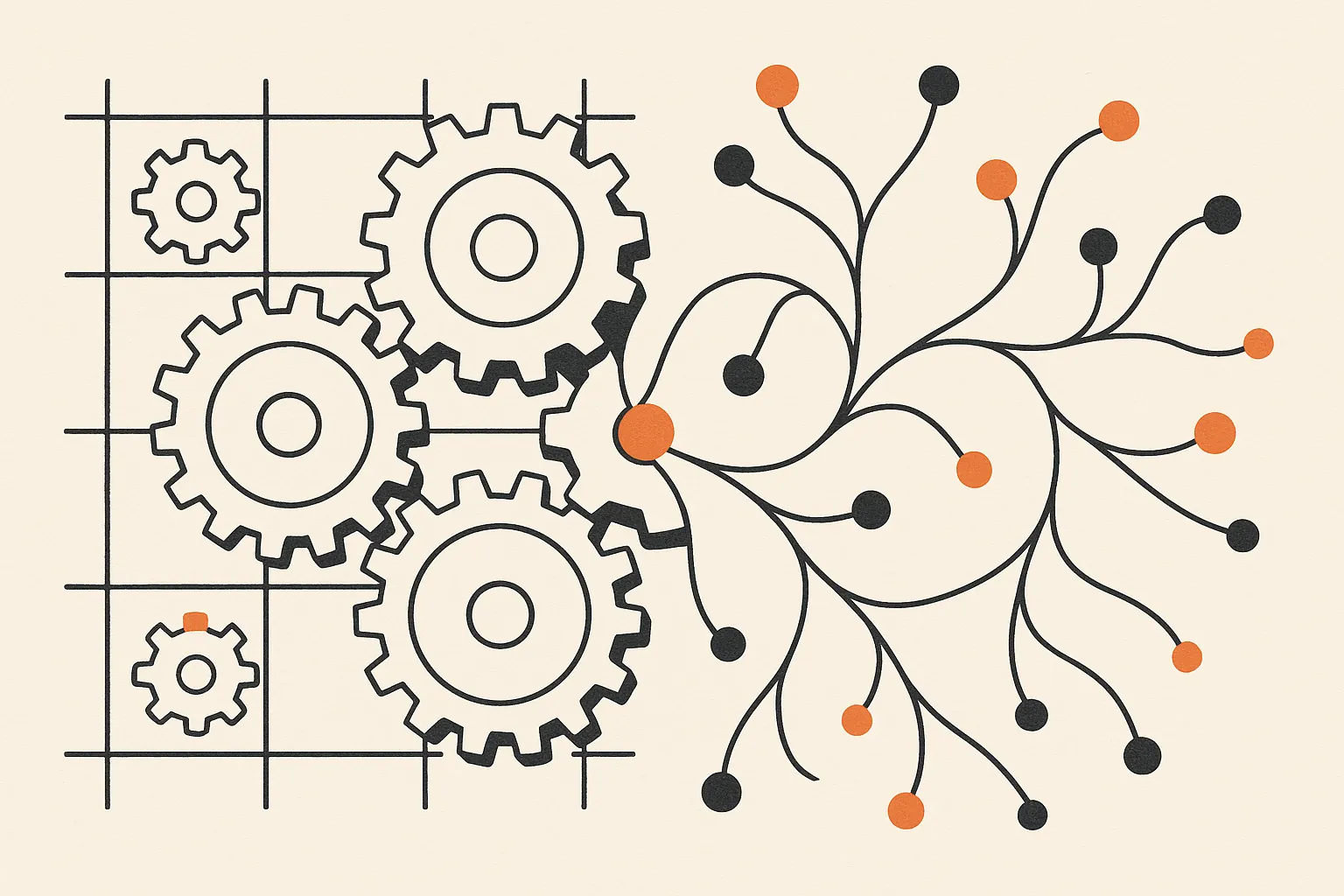
Automation follows rules you set. When this happens, do that. Move the invoice to this folder, send the reminder on day three, copy the form entry into the spreadsheet. It is predictable, it does exactly what you told it, and it has been quietly running businesses for decades. What has changed is how cheap and fast it now is to set up.
AI handles the work that does not fit clean rules: reading a messy email and working out what it is about, drafting a reply in your tone, pulling the point out of a long transcript, deciding which of forty cases needs a human. It deals in language and judgment instead of fixed steps. That is also why it is less predictable, and why it needs a person checking the edges rather than blind trust.
A rough test: if you can write the rule down as a flowchart, it is automation. If the rule is “use your judgment”, it is AI.
Where each one earns its keep
Automation wins when the task is repetitive and the steps never change. Routing leads to the right person, syncing data between two systems that refuse to talk, chasing overdue invoices, generating the same report on the same schedule. Boring, high-volume, rules-based work. If your team does it the same way every time, automate it.
AI wins when the task needs interpretation. Triaging an inbox where every message is different, turning a discovery call into a first-draft proposal, summarising what changed across a client's account and why it matters, drafting content that has to sound like you. Work that used to require a person to read, think, and write.
The honest answer for most businesses is that you need both, usually stitched together. The highest-leverage builds we ship are not “an AI”. They are automation doing the heavy lifting on the predictable parts, with a layer of AI judgment dropped in at the one or two points where a rule would not hold. The reporting tool we built for an agency is exactly this: automation pulls the numbers every week, AI writes the plain-English read on what moved, and the hard data sits next to it so nothing is taken on trust.
Case study · Paid mediaGoogle Ads reporting that reports itselfThe exact build described above, running across 60+ client accounts: automation pulls the numbers into Asana every week and AI writes the read on what moved. Thirty to forty hours a week handed back to the team.Read the case study →Why the distinction matters for your bottom line
Three reasons. First, cost and reliability: automation is cheaper to run and effectively never wrong within its rules, so paying for AI to do a job a simple rule could handle is waste. Second, trust: AI makes mistakes a person has to catch, which is fine for drafting a reply and not fine for moving money, so knowing which is which tells you where to keep a human in the loop. Third, where to start: owners who lead with “we need AI” often skip the unglamorous automation that would have paid back faster.
This is where the government's framing is actually useful. The strategy calls New Zealand a “smart adopter” rather than a frontier developer: the play is to put proven tools to work, not to build something experimental. That is the right instinct for a business too. You are not trying to invent AI. You are trying to take work off your most expensive people and lift the capacity of the team you already have.
How to find your first win this week
You do not need a strategy document to get started. You need a short, honest audit of where the hours go. Pick one role on your team and write down every recurring task that eats more than an hour a week: the report someone rebuilds every Monday, the inbox someone triages every morning, the data someone copies between two systems that refuse to talk. Be specific. “Admin” is not a task; “copying each new web enquiry into the CRM and assigning it” is.
Now sort that list with the flowchart test. For each task, ask whether you could hand it to a brand-new hire as a written set of rules and trust them to follow it exactly. If yes, it is automation, and it is almost always the cheaper, faster, more reliable thing to build first. If the task only works because an experienced person reads the situation and uses judgment, it is AI, and it will need a person reviewing the edges for a while.
Then rank what is left by hours saved, not by how impressive it sounds. The most valuable build is rarely the most exciting one. A rule that quietly routes every enquiry to the right person and chases the ones that go cold can return more hours in a month than a clever chatbot returns in a year. Start with the boring, high-volume task at the top of that list, ship it, measure the hours it actually gives back, and let that win fund the next one. Momentum compounds faster than ambition does.
If you get stuck, the blocker is usually not the technology. It is deciding where the line between rule and judgment actually sits for your business. That is the part worth getting a second opinion on before you spend anything.
The real risk is doing nothing
The same government research found that 68 percent of New Zealand's small and medium businesses had no plans to even evaluate AI. The most common reason owners gave was not cost or risk, it was a lack of in-house expertise, simply not knowing where to start. That gap is the actual problem. The businesses that pull ahead over the next few years will not be the ones that bought the most AI. They will be the ones that worked out, task by task, where a rule was enough and where judgment was needed, then built the boring thing first.
You do not need an AI strategy off the back of a government announcement. You need to look at where your team's time actually goes, separate the rules-based work from the judgment work, and start with whichever one buys back the most hours. Sometimes that is AI. More often, the first win is plain automation, and that is a feature, not a failure.